
Online VAT Calculator UK Add & Remove VAT Instantly
Net (ex VAT): £0.00
Gross (inc VAT): £0.00
VAT (at 20%): £0.00
Popular Worldwide VAT Rates
Please visit this site often to stay updated on VAT changes and rules.
How to Use the VAT Calculator
Using a vat calculator is simple, even if you have never worked with VAT before. The tool is designed to help beginners and professionals calculate VAT without confusion.
You only need to enter the amount and choose the VAT rate that applies to your product or service. Within seconds, the calculator shows the VAT amount and the final total.
This tool works for:
- Adding VAT to prices
- Removing VAT from totals
- Reversing VAT calculations
- Checking VAT invoices
- Creating accurate quotes
Many business owners rely on a add vat calculator to quickly calculate selling prices. Others use a remove vat calculator when they need to find the VAT portion inside a payment.
Using the VAT Calculator (Step-by-Step Guide)
If you are using VAT tools for the first time, follow this simple process. These steps help you calculate VAT correctly without confusion.
1) Enter the Original Amount
Start by typing the price into the calculator. This can be the net price (without VAT) or the total price (including VAT). For example, if your product costs £100 before VAT, enter 100 into the calculator. The tool will use this number to perform the calculation.
2) Choose the VAT Rate
Select the VAT rate that applies to your product or service. In the UK, the most common rate is 20 percent.
Some items may use different rates, such as 5 percent or 0 percent. Always check the correct rate before calculating VAT.
3) Choose Add or Remove VAT
If you want to add VAT to a price, choose the add VAT option. This is useful when creating invoices or setting product prices. If you already have a total price that includes VAT, select remove VAT. This helps you find the original price before VAT.
4) View Results Instantly
Once you enter the amount and select options, the calculator instantly shows results. You will see: VAT amount
Total price including VAT Original price excluding VAT This makes the reverse vat calculator useful for checking supplier invoices or payment totals.
How to Work Out VAT Manually
Although calculators make things easier, it is still useful to understand how VAT works manually. Knowing the basic method helps you double-check results and avoid mistakes.
To calculate VAT manually, you need the price and the VAT rate. Once you have these numbers, you can use simple multiplication and division.
Example Adding VAT Manually
Let’s say you want to add VAT to a product that costs £100. The VAT rate is 20 percent. First, multiply the price by the VAT rate. Then add that VAT amount to the original price.
Example: £100 × 20% = £20 VAT
£100 + £20 = £120 total price
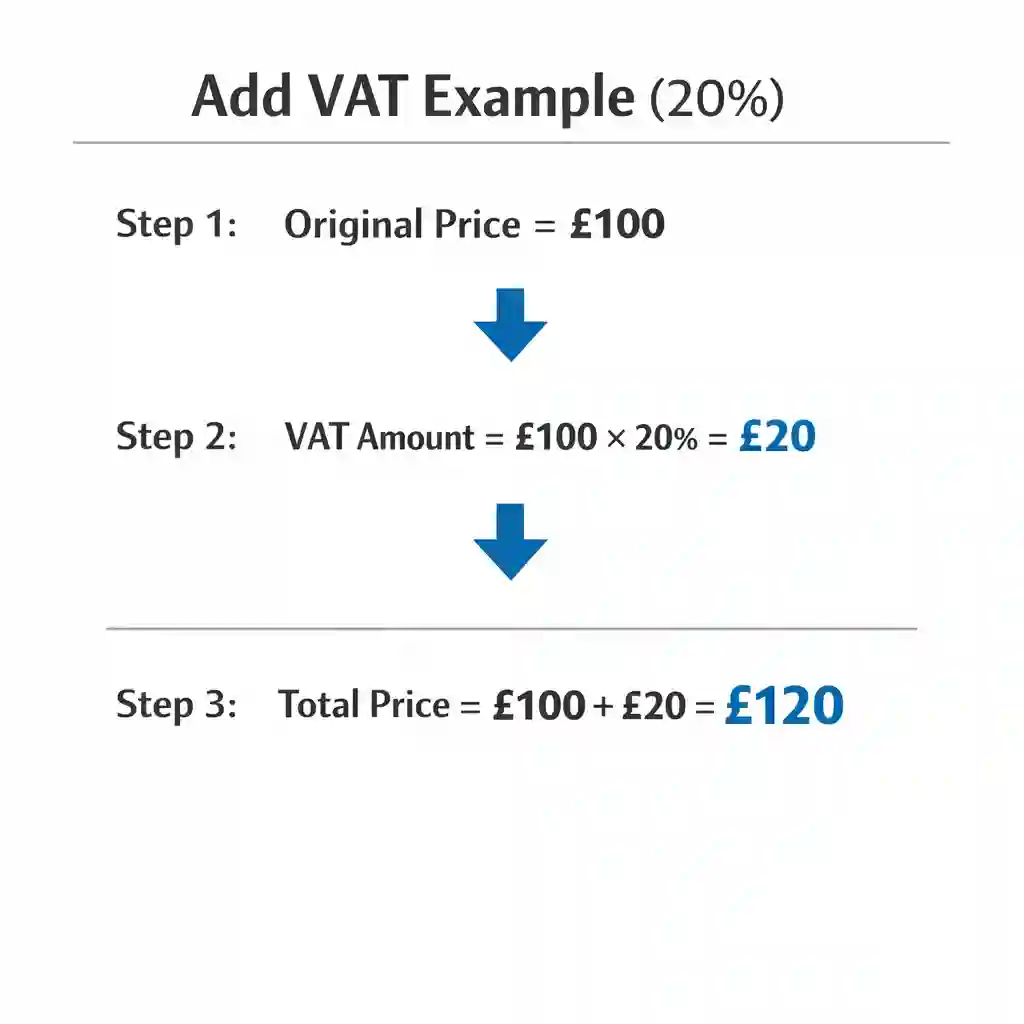
This is how businesses calculate selling prices with VAT included.
Example Removing VAT Manually
Removing VAT works differently because the VAT is already included in the total. You need to divide the amount instead of multiplying it.
For example, if the total price is £120 and includes VAT at 20 percent, divide by 1.20.
£120 ÷ 1.20 = £100 original price
VAT amount = £20
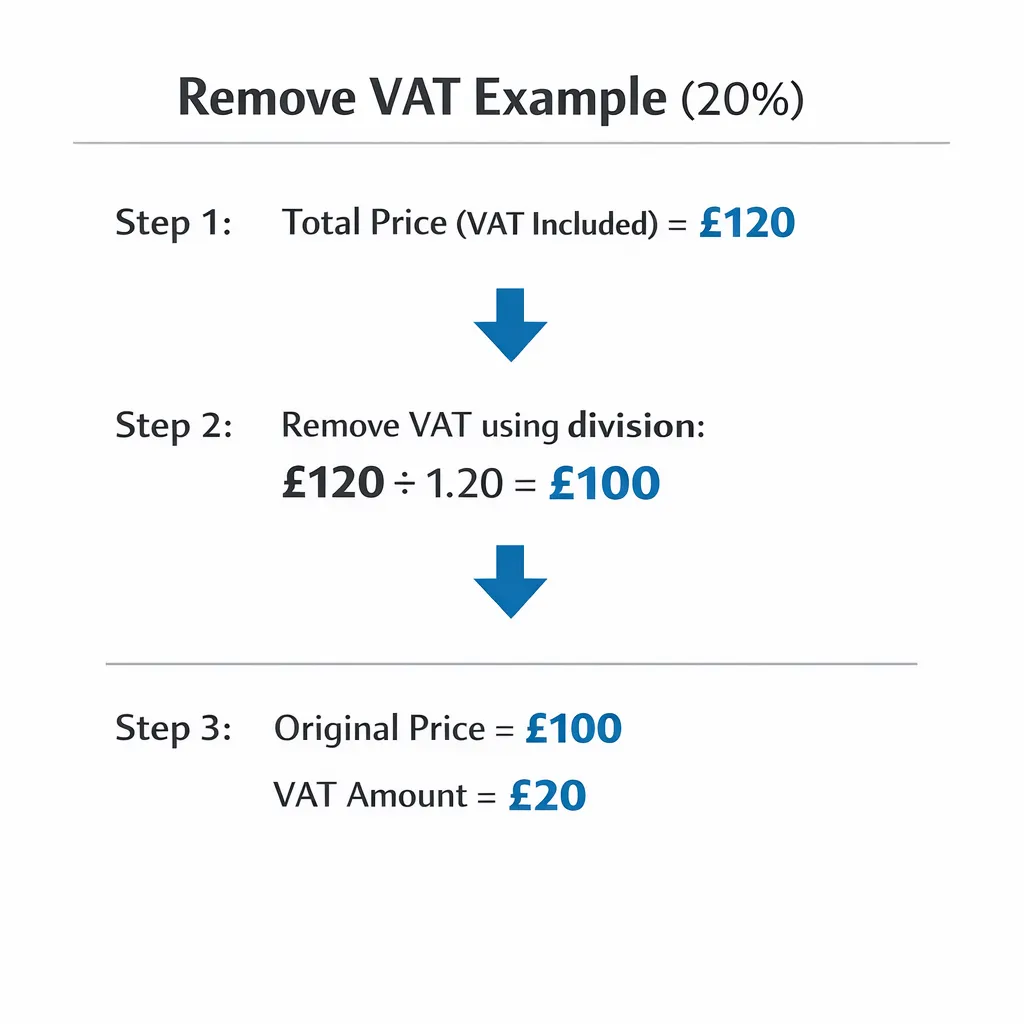
Many people use a remove vat calculator because this method can feel confusing at first.
VAT Inclusive vs VAT Exclusive
Understanding the difference between VAT inclusive and VAT exclusive prices is very important. These terms appear often on invoices, receipts, and quotes.
If you misunderstand these terms, you may charge the wrong amount or record incorrect values.
VAT Inclusive Meaning
VAT inclusive means the price already includes VAT. In other words, the total price shown is the final amount the customer pays.
For example, if a product is listed at £120 VAT inclusive, the VAT is already inside that price. You do not need to add VAT again.
Many retail stores display prices this way because customers prefer seeing the final total.
VAT Exclusive Meaning
VAT exclusive means VAT is not included in the price yet. This price shows the base cost before VAT is added.
For example, if a product costs £100 VAT exclusive, VAT will be added later. With 20 percent VAT, the final price becomes £120.
Businesses often use VAT exclusive prices when sending quotes or contracts.
Why This Difference Matters
Knowing whether a price is inclusive or exclusive is very important because it helps you avoid calculation mistakes. When you understand this clearly, it also becomes easier to prepare accurate invoices and price lists without errors.
Because of this, many people use a VAT inclusive calculator or VAT exclusive calculator to convert prices quickly. These tools make the process simple and help you get correct results in just a few seconds.
VAT Inclusive vs VAT Exclusive Comparison Table
| Feature | VAT Inclusive | VAT Exclusive |
|---|---|---|
| Meaning | Price already includes VAT. | Price does not include VAT yet. |
| Price Display | Shows the final amount to pay. | Shows the base price before VAT. |
| VAT Addition | No need to add VAT again. | VAT must be added later. |
| Example Price | £120 includes VAT already. | £100 becomes £120 after adding 20% VAT. |
| Common Usage | Retail stores and online shops. | Business quotes and contracts. |
| Customer Understanding | Easy to understand final price. | Requires calculation to know total. |
VAT Formula Explained
Understanding VAT formulas helps you calculate values with more confidence. Even if you use calculators every day, knowing how the formula works makes it easier to trust your results.
These formulas are actually simple once you understand what each number means.
Formula for Adding VAT
To add VAT, first multiply the original price by the VAT rate to find the VAT amount. After that, add the VAT amount to the original price to get the final total. The basic formula used for this calculation is VAT = Price × VAT Rate and Total Price = Price + VAT.
For example, suppose the original price is £80 and the VAT rate is 20 percent. When you multiply £80 by 20 percent, you get £16 VAT. After that, add £16 to £80, which gives a total price of £96. This method is widely used in add VAT calculators to quickly calculate the final amount including VAT.
Formula for Removing VAT
Removing VAT uses division because the VAT is already included in the total price. To find the original price, you divide the total amount by the VAT rate plus one. The basic formula used is Original Price = Total ÷ (1 + VAT Rate).
For example, suppose the total price is £96 and the VAT rate is 20 percent. When you divide £96 by 1.20, you get £80, which is the original price before VAT. After that, you can find the VAT amount by subtracting the original price from the total. In this case, £96 − £80 = £16 VAT. This method is commonly used in reverse VAT calculators to quickly find the original price before tax.
Reverse VAT Calculation Guide
Reverse VAT calculation means finding the original price before VAT from a total amount. This method is useful when you receive invoices where VAT is already included in the total price. Many businesses use reverse VAT when checking invoices or matching payments to make sure the amounts are correct.
When Reverse VAT Is Needed
Reverse VAT is useful in several situations. These include checking supplier invoices, checking expenses, and recording purchase costs.
For example, you might receive a bill showing £240 total including VAT, and you need to find out how much VAT is included in that amount. This is where a reverse VAT calculator becomes very helpful.
Reverse VAT Example
Let’s say you paid £240 for goods that include VAT at 20 percent.
To find the original price, divide the total amount by 1.20.
£240 ÷ 1.20 = £200 original price
To find the VAT amount, subtract the original price from the total.
£240 − £200 = £40 VAT
This simple method helps businesses keep their records correct and understand how much VAT was included in a payment.
Common Reverse VAT Mistakes
Some people subtract VAT instead of dividing by the correct number. This leads to wrong results and calculation errors.
Always remember that reverse VAT uses division, not subtraction. Using the correct method helps keep your numbers accurate.
Real-Life VAT Calculation Examples
Understanding VAT becomes much easier when you see real numbers. These examples show how VAT works in everyday business situations.
Many beginners struggle with VAT because formulas can feel confusing at first. Seeing practical examples helps you understand how the calculation works step by step.
Example 1: Adding VAT to a Product Price
Let’s say you sell a laptop for £500 before VAT. The standard UK VAT rate is 20 percent.
To calculate VAT, multiply £500 by 20 percent. This gives a VAT amount of £100.
Now add the VAT to the original price. The final selling price becomes £600.
Many sellers use an add VAT calculator to speed up this process and avoid mistakes when pricing many products.
Example 2: Removing VAT from a Total Price
Imagine you receive a payment of £240 that already includes VAT. You want to find the original price before VAT.
To remove VAT, divide the total by 1.20. This gives an original price of £200.
Next, subtract £200 from £240 to find the VAT amount. The VAT included is £40.
This is why a remove VAT calculator is useful when reviewing payments.
Example 3: VAT Calculation for Services
Suppose you are a freelance designer charging £300 for a project. VAT must be added at 20 percent.
Multiply £300 by 20 percent to get £60 VAT. Then add this to the original fee.
The final invoice total becomes £360, which is the amount your client pays.
Example 4: VAT Calculation for Discounts
Discounts slightly change how VAT is calculated. VAT must be calculated after applying the discount.
For example, a product costs £200 before VAT. A 10 percent discount reduces the price to £180.
Now calculate VAT on £180, not £200. At 20 percent VAT, the VAT amount becomes £36.
The final discounted price becomes £216, which ensures the VAT value stays correct.
Example 5: Reverse VAT for Purchase Records
A supplier sends you an invoice showing £480 total including VAT. You need to record the VAT portion.
Divide £480 by 1.20 to find the original price. This gives £400 as the base cost.
Subtract £400 from £480 to get £80 VAT. This helps keep your financial records correct.
This task becomes much easier when using a reverse VAT calculator.
Expert VAT Optimisation Tips
VAT optimisation means managing VAT in a way that follows tax rules while avoiding extra costs. In simple terms, it means handling VAT carefully so your business does not pay more than necessary. Many small businesses miss these simple steps and lose money without noticing it.
These practical ideas come from real business habits. Each one helps you save time, reduce mistakes, and keep your records clear.
Tip 1: Always Check the Correct VAT Rate
Different goods and services can use different VAT rates, so using the wrong rate can lead to incorrect invoices and totals. Always check the VAT rate before starting any calculation to avoid costly mistakes later.
Tip 2: Keep VAT Separate in Your Pricing
Many beginners mix VAT into prices without showing it clearly, which can make records difficult to understand. Displaying VAT separately on invoices helps improve clarity and makes tax reporting much easier.
Tip 3: Use Digital Tools Instead of Manual Math
Manual calculations increase the chance of mistakes, especially when working with many numbers throughout the day. Using a VAT calculator helps reduce errors, speeds up calculations, and makes repeated tasks easier to handle.
Tip 4: Review Supplier Invoices Carefully
Supplier invoices may sometimes include incorrect VAT values, which can affect your financial records if not checked properly. Reviewing each invoice carefully helps prevent mistakes and ensures that totals remain accurate.
Tip 5: Understand VAT Inclusive Pricing
Some businesses accidentally charge VAT twice because they misunderstand inclusive pricing. Understanding whether VAT is already included in the price helps prevent overcharging and keeps customer billing accurate.
Tip 6: Track VAT Payments Regularly
Leaving VAT checks until deadlines can create stress and increase the risk of mistakes. Reviewing VAT payments weekly or monthly helps you stay organised and reduces pressure during busy periods.
Tip 7: Separate VAT Funds from Business Funds
Spending VAT money by mistake can create serious cash shortages when tax deadlines arrive. Keeping VAT funds in a separate account helps protect your business and ensures that money is available when needed.
Tip 8: Claim VAT on Eligible Purchases
Many businesses forget to claim VAT on purchases, which leads to unnecessary financial losses over time. Keeping proper records of expenses makes it easier to claim VAT and reduce overall tax costs.
Tip 9: Use Standard Invoice Templates
Using different invoice formats can create confusion when reviewing records later. Standard templates help maintain consistency and ensure that VAT numbers, rates, and totals are always shown clearly.
Tip 10: Monitor VAT Threshold Changes
VAT rules and thresholds can change, and missing updates may lead to penalties or incorrect reporting. Checking official updates regularly helps your business stay within the rules and avoid unexpected problems.
Tip 11: Learn Basic VAT Formulas
Understanding simple VAT formulas makes it easier to detect mistakes and verify totals quickly. Even when using calculators, basic knowledge helps build confidence when reviewing numbers.
Tip 12: Keep VAT Records Organised
Disorganised records create stress during tax season and make it harder to find important documents. Storing invoices, receipts, and reports in clear categories saves time and reduces confusion later.
Tip 13: Seek Professional Advice When Needed
Some VAT situations can become more complex than expected, especially when business rules change. Speaking with an accountant or tax expert helps prevent costly mistakes and ensures your business follows correct procedures.
13 VAT Mistakes That Cost Small Businesses Thousands
Many small businesses lose money because of simple VAT mistakes. These errors may look small at first, but they can grow into serious money problems over time.
Learning about these mistakes helps you protect your business and avoid penalties. Each mistake below is based on common real business situations.
Mistake 1: Using the Wrong VAT Rate
Many businesses apply the standard 20 percent rate to everything. However, some items qualify for reduced or zero rates.
Using the wrong rate leads to incorrect invoices and tax returns. Check the correct VAT rate before billing customers.
Mistake 2: Forgetting to Register for VAT on Time
Some businesses delay VAT registration until it becomes urgent. This creates risk when revenue exceeds the legal threshold.
Late registration can lead to penalties and backdated VAT charges. Staying aware of thresholds helps prevent unexpected costs.
Mistake 3: Charging VAT Without Being Registered
New business owners sometimes charge VAT before registration approval. This creates rule-related problems and refund issues.
Wait until your VAT number is issued. Only then should VAT appear on invoices.
Mistake 4: Not Keeping VAT Records Properly
Poor record keeping causes stress during audits. Missing invoices create gaps that are difficult to explain.
Keeping organised records ensures accurate reporting. It also helps resolve issues quickly.
Mistake 5: Incorrect Reverse VAT Calculations
Reverse VAT calculations are often misunderstood. Some people subtract VAT instead of dividing correctly.
This leads to wrong expense totals and inaccurate records. Using a reverse VAT calculator helps reduce this risk.
Mistake 6: Mixing Business and Personal Expenses
Mixing expenses makes VAT claims confusing. It becomes difficult to show which costs belong to the business.
Separate accounts improve clarity and reduce audit risks. This habit helps protect accurate records.
Mistake 7: Ignoring VAT on Discounts
Discounted sales still require VAT calculations. Some businesses forget to adjust VAT after applying discounts.
Calculate VAT on the discounted amount. This keeps totals correct and within the rules.
Mistake 8: Not Checking Supplier VAT Numbers
Accepting invoices without valid VAT numbers can create problems later. Invalid invoices may prevent VAT claims.
Check supplier VAT details before recording purchases
Mistake 9: Misunderstanding VAT Inclusive Pricing
Some businesses charge VAT twice by mistake. This happens when inclusive prices are treated as exclusive.
Confirm whether VAT is already included before adding more. This helps prevent overcharging customers.
Mistake 10: Missing VAT Deadlines
Late VAT submissions result in penalties and interest charges. These costs can grow quickly over time.
Set reminders for filing deadlines. Planning ahead helps avoid unnecessary stress.
Mistake 11: Incorrect VAT Calculations on Imports
Imported goods often follow different VAT rules. Mistakes can increase customs and record errors.
Understanding import VAT helps prevent unexpected losses.
Mistake 12: Claiming VAT on Non-Eligible Expenses
Not every purchase allows VAT to be claimed back. Claiming VAT incorrectly may trigger audits.
Check whether the expense qualifies before making a claim.
Mistake 13: Relying Only on Memory Instead of Records
Some small businesses depend on memory instead of written records. This leads to missing transactions and incomplete reports.
Keeping written records ensures reliable financial history.
Do You Need to Register for VAT?
VAT registration becomes necessary when your business reaches certain income levels. Understanding these rules helps you follow tax laws and avoid penalties.
Many small businesses feel unsure about when to register. Knowing the VAT thresholds helps remove confusion and makes planning easier.
The 30-Day Forward-Looking Rule
This rule applies when you expect your income to go above the VAT threshold within the next 30 days. Even income you expect to receive soon counts toward VAT registration.
If your expected earnings go above the limit, registration becomes required. Planning ahead helps you avoid penalties and stay prepared.
Suppose you sign a contract worth £95,000 that will be paid within 30 days. Even if your past income was low, you must register for VAT because your expected income exceeds the threshold.
The Exception That Could Save You
Some businesses can qualify for special exceptions when their income increases for a short time. These exceptions depend on clear proof and accurate records.
If income goes up only once, you may not need to register immediately. However, you must keep proper records to support your case.
Example: VAT Exception Rule
Suppose your business receives a one-time contract worth £95,000, but you expect future income to stay below the VAT threshold. In this case, you may apply for an exception, but you must show records proving that the increase happened only once.
So Why Do Many Businesses Register Before They Have To?
Many businesses choose to register voluntarily before reaching the VAT threshold. This can offer several benefits for growing businesses.
Registered businesses can reclaim VAT on purchases, which helps reduce costs. It also builds trust with suppliers and clients.
Example:
Benefits of Voluntary VAT Registration
- Claim VAT back on purchases
- Build trust with larger clients
- Prepare business for growth
- Work easily with VAT registered suppliers
VAT Rates: The Cheat Sheet
Understanding VAT rates makes calculations easier and faster. Each category uses fixed percentages set by the government.
Keeping a quick reference list helps reduce mistakes when preparing invoices.
Standard VAT Rate
The standard UK VAT rate is 20 percent, and this rate applies to most goods and services sold by businesses. Common examples include electronics, clothing, and professional services.
Reduced VAT Rate
The reduced VAT rate is 5 percent, and it applies to selected items such as home energy supplies. This lower rate helps support essential living costs and reduces expenses for households.
Zero-Rated VAT
Zero-rated goods still count as taxable items, but VAT is charged at 0 percent. Examples include certain foods, books, and children’s clothing.
Why Zero-Rated Is Not the Same as Exempt
Zero-rated items allow businesses to claim back VAT on their purchases. Exempt items do not offer this benefit. Understanding this difference helps businesses recover VAT costs where allowed.
Unusual VAT Classifications
Some VAT categories may seem unusual or confusing at first. For example, certain foods qualify for a zero rate while similar items do not.
These classifications depend on detailed government rules, so it is important to check item categories carefully before applying VAT.
VAT for Freelancers
Many freelancers think VAT rules only apply to large companies. In reality, freelancers must follow the same VAT rules once their income goes above the registration threshold.
If you work as a designer, writer, consultant, or developer, VAT can become part of your daily work. Learning how VAT applies to freelance jobs helps you follow tax rules and work with confidence.
When Freelancers Must Register for VAT
Freelancers must register for VAT when their annual taxable turnover goes above the VAT threshold. This threshold can change from time to time, so checking the latest limit is important.
Even before reaching the threshold, some freelancers choose to register voluntarily. This allows them to claim VAT back on equipment and other business expenses.
VAT on Freelance Services
Most freelance services fall under the standard 20 percent VAT rate, which means VAT must be added to invoices after registration.
For example, if you charge £400 for a project, VAT at 20 percent adds £80. The total invoice amount becomes £480.
Using a VAT calculator helps freelancers prepare accurate invoices quickly and reduces the chance of mistakes.
Claiming VAT on Freelance Expenses
Freelancers often buy equipment, software, or office supplies as part of their work. Many of these purchases include VAT that can be claimed back.
For example, buying a laptop for £1,200 may include £200 VAT, which can often be recovered through a VAT return.
Keeping receipts organised makes it easier to claim VAT correctly and avoid missing important records.
VAT for Online Sellers
Online sellers deal with VAT every day because they sell products to customers in different locations. Understanding VAT rules helps prevent unexpected VAT costs and keeps pricing accurate.
E-commerce businesses must calculate VAT correctly for every sale. This includes both domestic sales and international orders, where VAT rules may be different.
VAT on UK Online Sales
If you sell products to customers within the UK, VAT applies based on the product category. Most items fall under the standard 20 percent VAT rate, so VAT must be added to the selling price.
For example, selling a product for £50 requires adding £10 VAT at 20 percent. The customer then pays £60 in total.
Using an add VAT calculator helps online sellers manage product pricing more easily and reduces the chance of mistakes.
VAT on International Sales
Selling products outside the UK introduces additional VAT rules that may differ from domestic sales. Some exports may qualify for zero-rated VAT, depending on the destination and product type.
For example, exporting goods to another country may not require UK VAT in some cases. However, proper records and shipping documents are needed to support zero-rated sales.
Understanding export rules helps prevent tax problems and keeps transactions accurate.
VAT on Online Marketplaces
Many online sellers use marketplaces or retail platforms to sell their products. These platforms sometimes collect VAT automatically on behalf of sellers.
Even when the platform collects VAT, sellers must still keep accurate records of each sale. Checking transactions regularly helps ensure proper reporting and avoids mistakes later.
VAT for Small Businesses
Small businesses often face VAT challenges as they grow and handle more sales. Understanding VAT early helps prevent mistakes and reduces financial stress later.
Whether you run a shop, agency, or service business, VAT soon becomes part of your regular work. Learning the basics early makes it easier to manage invoices and payments correctly.
Pricing Products with VAT
Small businesses must include VAT when setting product prices. This helps ensure profit remains accurate and costs are planned correctly.
For example, if a product costs £30 before VAT, adding 20 percent VAT increases the selling price to £36.
Using a VAT calculator UK helps businesses set correct prices quickly and reduces the risk of pricing mistakes.
Managing VAT Cash Flow
VAT collected from customers does not belong to the business, so it must be paid to the tax authority later. Keeping this in mind helps businesses avoid spending money that must be returned.
Setting aside VAT funds regularly helps prevent cash shortages. This simple habit protects businesses when payment deadlines arrive.
VAT for Growing Businesses
As businesses grow, VAT calculations become more frequent because the number of sales increases. Higher sales volumes also increase the risk of calculation mistakes.
Using reliable tools and keeping organised records helps support smooth growth and reduces pressure during busy periods.
VAT Invoice Example
A VAT invoice is a document that shows VAT details for a sale or service. It includes important information such as the VAT amount, total price, and business details.
Understanding how VAT invoices work helps businesses keep records accurate and present their work in a professional way.
What a VAT Invoice Must Include
A valid VAT invoice contains several important details that confirm VAT has been charged correctly. These details help both buyers and sellers keep accurate records and avoid confusion later.
Key elements include:
- Business name and address
- VAT registration number
- Invoice number
- Invoice date
- Description of goods or services
- Price before VAT
- VAT amount
- Total price including VAT
Including these details ensures transparency and makes invoices easier to understand and verify.
Example VAT Invoice Calculation
Imagine you sell office furniture worth £250 before VAT. If VAT is charged at 20 percent, the VAT amount becomes £50.
Your invoice would show:
- Price before VAT: £250
- VAT (20%): £50
- Total price including VAT: £300
This simple format helps customers clearly understand how the final price is calculated.
VAT Return Explained
A VAT return is a report that businesses send to the tax authority showing how much VAT they collected from customers and how much VAT they paid on purchases. Most businesses submit VAT returns on a monthly or quarterly basis, depending on their setup.
Understanding how VAT returns work helps you track your taxes correctly and avoid reporting mistakes.
What Information Goes into a VAT Return
VAT returns include details about total sales, total purchases, and VAT amounts. These figures show how much VAT must be paid or claimed back.
Businesses usually report the following:
- VAT collected on sales
- VAT paid on purchases
- Net VAT payable
Keeping accurate records helps ensure correct reporting and reduces the risk of mistakes.
Example VAT Return Scenario
Suppose your business collected £2,000 VAT from customers during a reporting period. During the same period, you paid £500 VAT on business purchases.
To calculate the VAT due, subtract purchase VAT from sales VAT.
£2,000 − £500 = £1,500 VAT payable
This means £1,500 must be paid to the tax authority. Using clear and structured calculations helps prevent confusion during VAT reporting.
VAT Record Keeping Guide
Good record keeping is the backbone of following VAT rules. Without clear records, businesses often face problems during tax checks or audits.
Keeping records organised improves accuracy and helps businesses feel more confident when preparing VAT reports.
What Records You Must Keep
Businesses must store documents that support their VAT calculations. These records help prove that your reports are correct and complete.
Common records include:
- Sales invoices
- Purchase receipts
- VAT return summaries
- Bank statements
Keeping these records organised helps prevent delays during tax checks or audits.
How Long Records Should Be Stored
VAT records usually need to be stored for several years, depending on the tax rules in your country. Checking the required storage period helps avoid problems later.
Keeping long-term records protects businesses during financial reviews and tax inspections.
Digital vs Paper Records
Many businesses now store their records digitally because it saves space and makes files easier to find. Digital storage also reduces physical clutter and improves accessibility.
However, paper copies can still be useful as backups in case digital files are lost. Using both digital and paper records increases reliability and keeps information safer.
How to Avoid VAT Penalties
VAT penalties often happen when businesses miss deadlines or keep incorrect records. Avoiding these mistakes helps protect your business money and prevents extra costs.
Following simple habits, such as checking deadlines and keeping records organised, helps reduce the risk of penalties.
Submit VAT Returns on Time
Late VAT submissions often lead to penalties and extra interest charges, which can increase business costs over time. Setting reminders in advance helps ensure that returns are filed on time.
Planning ahead also reduces last-minute pressure and makes the filing process easier to manage.
Double-Check All VAT Figures
Small calculation mistakes can quickly turn into large financial problems if they are not noticed early. Reviewing numbers carefully before submission helps ensure that VAT totals remain accurate.
Using a remove VAT calculator can also help confirm totals and reduce the chance of reporting errors.
Keep Updated with VAT Rules
VAT rules can change from time to time, and missing updates may lead to incorrect reporting. Staying informed helps businesses continue to follow tax rules correctly.
Checking official updates regularly ensures that VAT calculations remain accurate and up to date.
VAT on Imports and Exports
Businesses that trade internationally must understand how VAT works on imports and exports. These rules are different from domestic sales and often involve additional charges and paperwork.
Understanding these differences helps prevent unexpected VAT costs and keeps international transactions running smoothly.
VAT on Imports
Imported goods usually include VAT charges at customs when they enter the country. Businesses must record these costs carefully to keep their VAT reports accurate.
For example, importing goods worth £1,000 may include £200 VAT. This VAT amount can often be claimed back later through a VAT return.
VAT on Exports
Exports to other countries may qualify for zero-rated VAT, depending on the destination and product type. However, proper shipping and sales records are required to support zero-rated exports.
Keeping export records organised helps businesses follow VAT rules and avoid reporting problems.
Common Import VAT Mistakes
Some businesses forget to record import VAT in their accounts. This leads to incorrect financial records and reporting errors.
Using organised systems helps track import VAT correctly and reduces the risk of missing important details.
VAT on Digital Services
Digital services include online products, software subscriptions, and streaming services that are sold through the internet. VAT rules for digital services often depend on the customer’s location rather than the seller’s location.
Understanding these rules helps online businesses apply the correct VAT rate and avoid reporting mistakes.
VAT on Digital Products
Digital goods sold online often require VAT based on the customer’s country rather than the seller’s location. This makes pricing slightly more complex, especially when customers are based in different regions.
For example, selling software subscriptions or downloadable products may involve different VAT rates depending on where the customer lives. Using a VAT calculator helps verify totals and apply the correct VAT rates when working with international customers.
VAT on Subscription Services
Subscription-based businesses charge customers on a regular basis, such as monthly or yearly payments. Each payment must include VAT when applicable, just like one-time purchases.
Tracking recurring VAT carefully helps businesses keep their reports accurate and avoid missed entries.
Managing Digital VAT Records
Digital businesses must store transaction details carefully, especially when selling to customers in multiple countries. These records support VAT calculations and help prove that correct VAT rates were applied.
Keeping accurate data reduces the risk of errors and makes VAT reporting easier to manage.
Benefits of Using VAT Calculator
Using a VAT calculator saves time and reduces the risk of manual errors. It simplifies calculations that would normally take several steps and require extra checking.
Many businesses process dozens of invoices every day, which increases the chance of small mistakes. Using a reliable tool helps keep each calculation consistent and accurate.
Saves Time During Daily Work
Manual VAT calculations often take more time, especially when working with many numbers throughout the day. Each extra step increases the chance of small mistakes and slows down daily tasks.
For example, if you sell 25 items daily at £40 each, repeating the same VAT calculation again and again can waste valuable time. Using a VAT calculator helps complete these calculations quickly and keeps your work moving smoothly.
Reduces Calculation Errors
Human errors can happen even when working with simple numbers, especially when calculations are repeated many times. A single wrong entry can lead to incorrect invoices and financial confusion.
Using calculation tools helps prevent these mistakes and keeps results consistent across multiple transactions.
Improves Professional Accuracy
Professional invoices require correct VAT totals so customers can clearly understand what they are paying. Even small errors can affect trust and create confusion during payments.
Using a calculator improves consistency in your invoices and helps build trust between businesses and their clients.
Helpful for Beginners
New business owners often feel confused when learning VAT formulas for the first time. Manual calculations may feel difficult, especially without much experience.
Using automated tools makes the process easier by handling the calculations in seconds. This helps beginners understand VAT faster and gain confidence in their daily work
Manual VAT Calculation vs Calculator
Both manual methods and digital tools can be used to calculate VAT, and each method has its own advantages. However, most modern businesses prefer automated tools because they save time and reduce the chance of mistakes.
Understanding the difference between manual calculations and VAT calculators helps you choose the method that best suits your daily work and business needs.
Manual VAT Calculation vs VAT Calculator
| Feature | Manual VAT Calculation | VAT Calculator |
|---|---|---|
| Speed | Takes more time | Very fast results |
| Accuracy | Higher risk of errors | More accurate results |
| Ease of Use | Requires formula knowledge | Simple to use |
| Suitable For | Small calculations | Large and repeated calculations |
| Error Risk | Higher | Lower |
Manual VAT Calculation
Manual VAT calculation involves using formulas to work out VAT totals step by step. This method requires careful attention to numbers and a clear understanding of VAT formulas.
While manual calculation is useful for learning, it usually takes more time to complete. It also increases the chance of errors, especially during busy working periods.
Using a VAT Calculator
Using a VAT calculator UK makes the entire process much easier and faster. You simply enter the amount and select the correct VAT rate for your calculation.
The calculator then completes all steps instantly, which saves time and improves overall accuracy when working with multiple invoices.
Which Method Is Better?
Manual calculation helps build knowledge and improves your understanding of VAT formulas. However, VAT calculators provide speed and reliability, making them more practical for daily tasks.
Most businesses use both methods together. They learn the formulas for understanding but rely on calculators to handle everyday calculations.
Global VAT Rates Compared
VAT systems exist in many countries around the world, but each country applies its own rates and rules. These differences can affect pricing, profits, and overall business planning.
Understanding global VAT rates helps businesses that trade internationally apply the correct taxes and avoid unexpected costs when selling across borders.
Global VAT Rate Comparison Table
| Country | Standard VAT / GST Rate | Tax Name | Notes |
|---|---|---|---|
| United Kingdom | 20% | VAT | Standard rate for most goods and services |
| Germany | 19% | VAT | Reduced rate of 7% applies to some goods |
| France | 20% | VAT | Reduced rates available for selected services |
| Spain | 21% | VAT | Reduced rates at 10% and 4% |
| Italy | 22% | VAT | One of the higher VAT rates in Europe |
| Netherlands | 21% | VAT | Reduced rate of 9% applies to essentials |
| Ireland | 23% | VAT | Among the higher VAT rates in the EU |
| Sweden | 25% | VAT | Highest standard VAT rate in Europe |
| Norway | 25% | VAT | Reduced rates available for selected goods |
| Denmark | 25% | VAT | No reduced rate on most items |
| Poland | 23% | VAT | Reduced VAT available for selected goods |
| Portugal | 23% | VAT | Reduced rates vary by region |
| Canada | 5% | GST | Combined with provincial taxes in some regions |
| Australia | 10% | GST | Applies to most goods and services |
| New Zealand | 15% | GST | Broad-based tax system |
| United Arab Emirates | 5% | VAT | Introduced in recent years |
| Saudi Arabia | 15% | VAT | Increased from 5% to 15% |
| India | 18% | GST | Multiple GST slabs available |
| South Africa | 15% | VAT | Applies to most goods and services |
| Singapore | 9% | GST | Recently increased from 8% |
VAT Rates in Europe
Many European countries use VAT systems that are similar to the UK system. Standard VAT rates in Europe usually range between 19 percent and 25 percent, depending on the country.
For example, Germany uses a 19 percent VAT rate, while France commonly applies a 20 percent VAT rate on most goods and services.
VAT Rates Outside Europe
Countries outside Europe also apply similar taxes on goods and services. Some countries call this tax VAT, while others use different names such as GST.
For example, Australia uses GST at 10 percent, while Canada uses GST or HST, depending on the province or region.
Why Global VAT Knowledge Matters
Businesses that sell products internationally must understand VAT rates used in other countries. Incorrect pricing can lead to reporting problems and unexpected tax costs.
Knowing global VAT rates helps businesses create accurate invoices and manage international sales with greater confidence.
VAT Glossary
Understanding VAT terminology makes calculations easier and helps reduce confusion when working with invoices and reports. This glossary explains common VAT terms in simple language so beginners can understand them quickly.
Learning these key terms helps you read business documents more confidently and understand financial reports more clearly.
VAT stands for Value Added Tax, which is a tax added to goods and services at different stages of sale. This tax is usually included in the final price that customers pay.
VAT Rate
The VAT rate refers to the percentage applied to goods or services when calculating VAT. Common UK VAT rates include 20 percent, 5 percent, and 0 percent, depending on the product type.
Knowing the correct VAT rate helps ensure that calculations remain accurate.
VAT Inclusive
VAT inclusive means the VAT amount is already included in the total price shown. Customers simply pay the displayed price without adding extra VAT.
This pricing format is commonly used in retail stores where customers prefer to see the final price.
VAT Exclusive
VAT exclusive means VAT is not included in the displayed price. The VAT amount must be added later to find the final total.
Businesses often use VAT exclusive pricing in contracts, quotations, and business invoices.
VAT Return
A VAT return is a report that businesses send to the tax authority. It shows how much VAT was collected from sales and how much VAT was paid on purchases.
Most businesses submit VAT returns monthly or quarterly.
Input VAT
Input VAT refers to the VAT paid on business purchases such as equipment, supplies, or services. Businesses may be able to claim this VAT back if the purchase qualifies.
Keeping receipts helps support Input VAT claims.
Output VAT
Output VAT refers to the VAT charged to customers when selling goods or services. This amount must be recorded and reported in VAT returns.
Tracking Output VAT carefully helps maintain accurate financial records.
History of VAT
VAT has a long history that dates back several decades, and understanding its origin helps explain how the system works today. Many countries introduced VAT to create fair tax systems and improve the way taxes were collected from businesses and customers.
Early Development of VAT
VAT was first introduced in France during the mid-20th century as a way to simplify indirect taxes collected on goods and services. The new system made tax collection more organised and easier to manage.
Other countries quickly adopted similar methods after seeing its success. This helped create a more consistent tax approach across different regions.
VAT Adoption in the UK
The United Kingdom introduced VAT in 1973 when it joined the European Economic Community (EEC). This new system replaced older purchase taxes that were more complicated to manage.
Since then, VAT has remained an important part of the UK tax system and continues to support government revenue.
Modern VAT Systems
Today, VAT systems depend heavily on digital tools that help businesses record and report their transactions. Online reporting systems and automated calculations have improved accuracy and reduced manual work.
Modern technology continues to make VAT management easier, faster, and more reliable for businesses of all sizes.
About This VAT Calculator
This VAT calculator is designed to support businesses of all sizes, from small startups to growing companies. It provides fast and accurate calculations for different VAT situations, helping users save time during daily work.
Whether you need to add VAT, remove VAT, or calculate reverse VAT, this tool delivers reliable results that make pricing and invoicing easier.
Designed for UK Businesses
This calculator is built to follow UK VAT rules and rates, making it suitable for local businesses and service providers. It supports standard, reduced, and zero VAT calculations based on common UK tax requirements.
Businesses can rely on correct formulas that help maintain accurate records and improve confidence when handling VAT.
Built for Accuracy and Speed
Every calculation runs instantly, allowing users to complete VAT tasks without delays. This helps save time when preparing invoices, checking prices, or reviewing financial records.
Reliable results also reduce pressure during busy reporting periods and help prevent costly calculation mistakes.
Suitable for All Experience Levels
This tool is designed for both beginners and experienced users who need quick VAT results. Beginners benefit from simple input steps, while experienced users benefit from consistent and reliable calculations.
This makes the calculator suitable for freelancers, online sellers, small businesses, and growing companies.
Frequently Asked Questions
This section answers common VAT questions that many users search online. These answers help beginners understand VAT rules clearly.
Final Words
Managing VAT does not have to be difficult or stressful when you have the right knowledge and tools. With clear understanding and proper methods, VAT calculations become simple, accurate, and easier to manage.
Using a trusted VAT calculator helps businesses work faster, avoid mistakes, and follow UK tax rules correctly. Whether you run a small shop, freelance service, or online store, accurate VAT calculations support long-term financial success and stable business growth.
Official VAT Resources
For the latest VAT rules, rates, and registration details, always refer to the official HMRC VAT guidance to ensure your calculations follow current UK tax requirements.
You can also review the HMRC VAT rates and HMRC VAT registration threshold pages for updated information.