VAT Threshold 2026 UK: New Limit, Rules & 2025–2026 Updates
If you run a small business in the UK, one number can change your whole tax situation. That number is the VAT threshold 2026 UK, and understanding it early can help you avoid costly mistakes. Many business owners cross this limit without noticing, and when that happens, late registration often leads to penalties that reduce profits.
Introduction
Running a business often feels like balancing many small tasks at once. You track sales, talk to customers, and manage expenses every day. But there is one thing that quietly grows in the background your yearly turnover.
Once your turnover crosses the VAT threshold 2026 UK, you must register for VAT. This rule applies to most businesses that sell goods or services in the UK and follow HMRC VAT rules. If you miss the deadline, HMRC can charge penalties, and that can affect your business cash flow.
In this guide, we will walk through everything you need to know about the VAT threshold 2026 UK, including when to register for VAT UK and how the rules apply to your business. We will compare the 2025 and 2026 limits, explain the rules in simple words, and share practical examples that help you understand how this works in real life.
You will also see helpful tables and clear examples that make the topic easy to follow, even if this is your first time learning about VAT or tracking your taxable turnover.
What Is the VAT Threshold 2026 UK
The VAT threshold 2026 UK is the amount of yearly turnover your business can earn before VAT registration becomes mandatory. This limit is also known as the vat registration threshold uk 2026, and it applies to most businesses that sell goods or services.
Turnover means the total value of everything you sell before expenses are removed. It includes all goods and services, and many new business owners confuse profit with turnover because both numbers look similar at first. However, VAT rules focus only on turnover, which is also called your vat turnover threshold uk.
For 2026, the VAT threshold remains an important number for small and growing businesses. If your sales reach this amount in any rolling 12-month period, you must register for VAT and follow the correct reporting process.
This rule does not apply only to large companies. It also applies to small online stores, service providers, freelancers, and local shops that generate steady income throughout the year.
If you are still learning about VAT basics, you should also read: VAT Registration UK Guide
This guide explains the full VAT registration process step by step and helps you understand when to register for VAT UK without missing important deadlines.
Current VAT Threshold for 2026
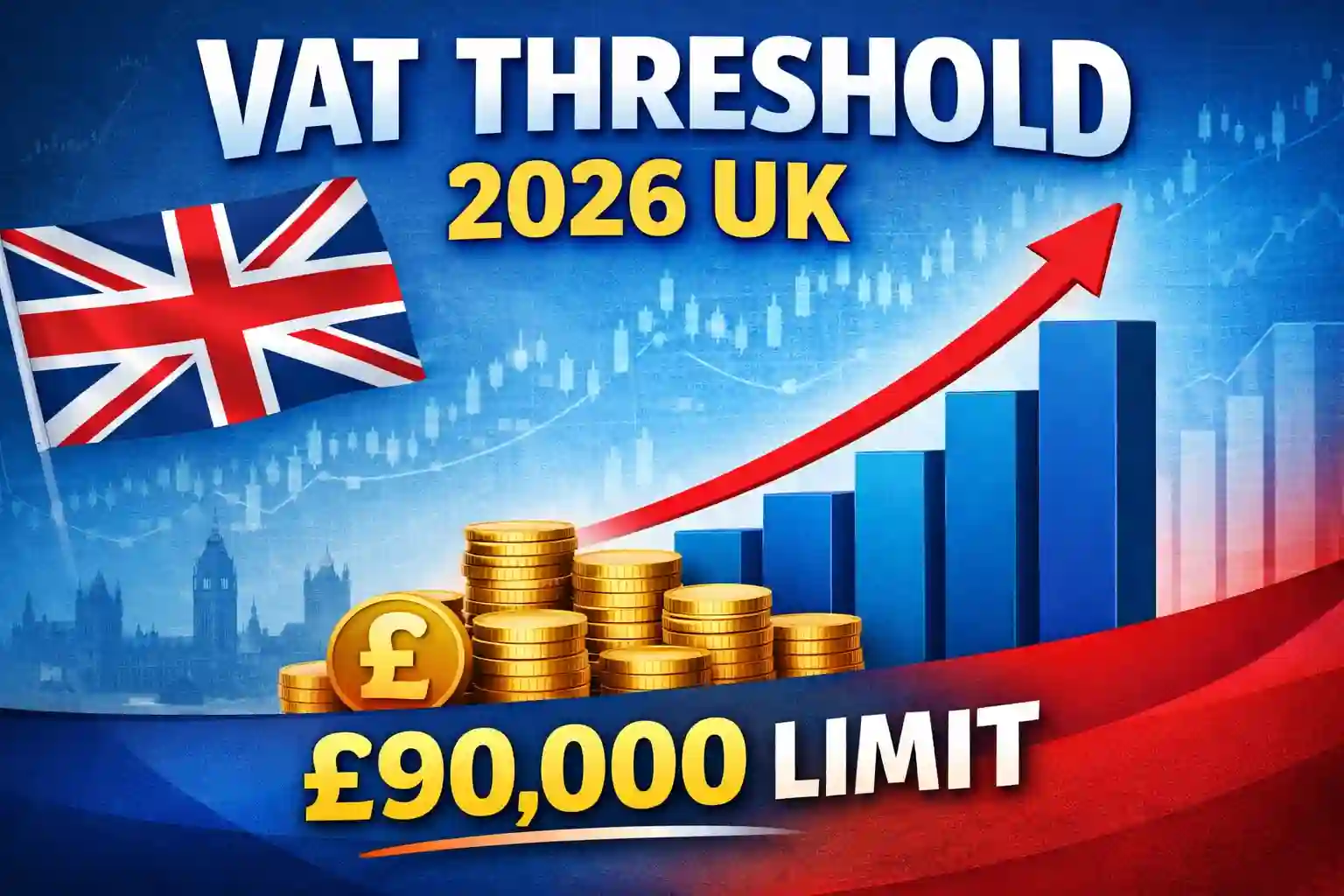
The most important detail business owners want to know is the exact VAT limit. The VAT threshold 2026 UK sets the amount your business can earn before VAT registration becomes mandatory. Knowing this vat threshold 2026 UK limit helps businesses plan ahead and avoid missing registration deadlines.
Below is the latest threshold amount for the UK.
VAT Threshold 2026 Current Limit
| Category | Threshold Amount |
|---|---|
| VAT Registration Threshold | £90,000 |
| VAT Deregistration Threshold | £88,000 |
The registration threshold means you must register once your taxable turnover exceeds £90,000 within any rolling 12-month period. This figure is known as the vat registration threshold uk 2026, and businesses must monitor their income carefully to stay compliant.
The deregistration threshold means you may cancel VAT registration if your turnover drops below £88,000. This level is often called the vat deregistration threshold uk, and it helps businesses decide when VAT registration is no longer required.
These limits help businesses understand when VAT becomes required and when it may no longer be needed. Keeping track of these numbers each month makes it easier to stay within HMRC VAT rules and avoid penalties.
If you want to calculate your VAT quickly, you can also use: VAT Calculator UK This tool helps you check VAT amounts in seconds and supports accurate VAT calculations for daily business use.
VAT Threshold 2025 vs 2026 Comparison
Many business owners wonder if the threshold changed between 2025 and 2026. Comparing these two years helps you understand how stable the rules are and how the VAT threshold 2026 UK compares with previous limits.
Below is a simple vat threshold 2025 vs 2026 comparison table that shows the latest figures clearly.
VAT Threshold Comparison Table
| Year | VAT Threshold |
|---|---|
| VAT Threshold 2025 | £90,000 |
| VAT Threshold 2026 | £90,000 |
The threshold remained the same in both years, which shows that the vat threshold comparison UK has stayed stable during this period. This stability helps businesses plan ahead without sudden changes in tax responsibilities or unexpected financial pressure.
When the threshold stays steady, business owners can predict when they might need to register. That makes budgeting easier because businesses can estimate their future tax responsibilities and manage their cash flow more effectively.
Even though the number stayed the same, the rules about monitoring turnover still apply every month. Businesses must keep checking their income regularly to make sure they follow HMRC VAT rules and avoid missing the registration deadline.
VAT Threshold History Table (2017–2026)
Understanding the vat threshold history UK gives you a clearer picture of how tax rules have changed over time. When you review past values, it becomes easier to understand vat threshold changes UK and predict how future limits may affect your business planning.
Below is the complete VAT threshold history table showing yearly limits from 2017 to the VAT threshold 2026 UK.
VAT Threshold History Table
| Year | VAT Threshold |
|---|---|
| 2017 | £85,000 |
| 2018 | £85,000 |
| 2019 | £85,000 |
| 2020 | £85,000 |
| 2021 | £85,000 |
| 2022 | £85,000 |
| 2023 | £85,000 |
| 2024 | £90,000 |
| 2025 | £90,000 |
| 2026 | £90,000 |
For many years, the VAT threshold remained fixed at £85,000, which helped businesses maintain stable planning and predictable tax responsibilities. In 2024, the threshold increased to £90,000, and that same figure continues into 2025 and the VAT threshold 2026 UK, allowing businesses slightly more room to grow before VAT registration becomes mandatory.
This increase allowed many small businesses to expand their operations without needing immediate VAT registration. It also supported better financial planning because businesses could operate longer before reaching the vat registration threshold UK.
If you want to understand how VAT applies to different goods and services, you can also check: VAT Rates UK Guide This guide explains standard, reduced, and zero VAT rates, helping you understand how different VAT rates affect pricing and customer charges.
Who Needs to Register for VAT in 2026
Many people believe VAT registration applies only to large companies, but this idea is not correct. In reality, even small businesses must register once they cross the VAT threshold 2026 UK, and understanding who needs to register for VAT UK helps businesses stay compliant with tax rules.
You must register for VAT in 2026 if any of the following situations apply to your business:
- Your taxable turnover exceeds £90,000 within any rolling 12-month period
- You expect to cross the threshold soon based on future sales
- You take over a VAT-registered business
- You sell goods or services that fall under VAT registration rules UK
These rules apply to many different types of businesses, not just large companies. Businesses that commonly need VAT registration include:
- Online sellers running ecommerce stores
- Freelancers offering digital or creative services
- Contractors working on long-term projects
- Retail shops selling goods to customers
- Service providers offering repairs, consulting, or maintenance services
Even small online businesses selling digital services can cross the threshold faster than expected. That is why monthly tracking of business turnover UK becomes very important, especially for businesses experiencing steady growth.
If your business sells products or services regularly, you should also understand how VAT calculations affect your pricing and profit margins. VAT Calculator UK This tool helps you calculate VAT amounts quickly and supports accurate pricing decisions for everyday business transactions.
When You Must Register for VAT
The timing of VAT registration matters just as much as the threshold amount. Many businesses delay registration because they misunderstand the timeline, especially when they are unsure when to register for VAT UK after reaching the VAT threshold 2026 UK.
VAT registration usually becomes mandatory in two main situations, and understanding these rules helps businesses avoid missing the VAT registration deadline UK.
Situation 1: You Already Crossed the Threshold
If your turnover passes £90,000, you must register within 30 days of the end of the month in which the threshold was crossed. This rule applies to any business that exceeds the vat registration threshold UK, even if the increase happens suddenly.
For example, imagine your turnover crossed the threshold in July. In this case, you must register before the end of August to stay compliant with HMRC VAT rules.
Missing this deadline can result in penalties, interest charges, and unexpected financial pressure for your business.
Situation 2: You Expect to Cross the Threshold
Sometimes businesses know they will exceed the threshold soon. In that case, you must register before crossing the limit to avoid late registration.
For example, if you sign a large contract that will push your turnover beyond £90,000, you should prepare for VAT registration early. You can estimate your VAT amounts using: VAT Calculator online helps you calculate VAT amounts quickly and supports accurate planning before registration becomes mandatory. Planning ahead reduces stress and helps businesses stay prepared for future tax responsibilities.
What Happens If You Cross the VAT Threshold
Crossing the VAT threshold 2026 UK without registering can create serious problems for your business, especially if you do not understand what happens if you exceed VAT threshold UK at the right time. Many small businesses learn this lesson the hard way because they delay registration and later face unexpected penalties that affect their cash flow.
When your turnover exceeds the threshold, the first responsibility is to register for VAT within the required time limit after crossing the vat registration threshold UK. Once your registration is approved, you must begin charging VAT on all taxable sales made to customers, and this becomes part of your regular business routine. Failing to register on time can lead to penalties under HMRC VAT penalty rules, which may increase depending on how late the registration happens.
After registration, businesses must submit VAT returns regularly to report their sales and VAT activity. Most businesses submit VAT returns every three months, although some may follow different schedules depending on their VAT scheme. Submitting accurate returns helps businesses stay compliant with HMRC VAT rules and reduces the risk of financial errors that could lead to additional charges.
Businesses must also pay the VAT collected from customers to HMRC within the required deadline. This payment represents the VAT amount charged during the reporting period, and it must be transferred correctly to avoid delays. If registration or return submission is delayed, VAT late registration penalty UK charges may apply, and these penalties depend on how late the registration happens and how much VAT is owed.
Keeping accurate records of invoices, sales, and expenses makes this entire process easier and more manageable. Good record keeping also helps businesses avoid mistakes during reporting and ensures that all VAT-related transactions follow proper HMRC VAT compliance rules.
Real-Life VAT Threshold Example
Let’s look at a simple example to understand how this works in real life and how businesses can track their vat turnover threshold UK without confusion.
Asad runs a small online clothing store from his home. During the first few months, his sales are slow, and he earns around £4,000 per month, which keeps his yearly turnover below the registration limit.
Over time, his business becomes popular, and his monthly sales begin to increase. His income rises to £8,000, then £9,000 per month, and by the end of the year, his total turnover reaches £91,000, which pushes his business beyond the VAT threshold 2026 UK.
At this point, Asad must register for VAT within 30 days of crossing the limit. Once registered, he begins charging VAT on each product he sells, and this becomes part of his regular pricing process.
If Asad wants to check his VAT amounts or estimate how close he is to the threshold, he can calculate his figures using: VAT Calculator UK This tool helps businesses understand how to calculate VAT threshold UK and estimate VAT charges before registration becomes mandatory.
If Asad had ignored the threshold, he could have faced penalties and unexpected tax payments that might affect his business income. This example shows how quickly turnover can grow and why regular monthly tracking is necessary for staying within HMRC VAT rules.
How to Calculate VAT Threshold for Your Business
Many business owners believe VAT threshold calculation is difficult at first, but the process becomes easier once you understand how to calculate VAT threshold UK using a clear method. The key idea is learning how turnover works over a rolling 12-month period.
The VAT threshold 2026 UK is based on a rolling 12-month total rather than a fixed calendar year. Businesses cannot simply check January to December because VAT rules require checking the most recent 12 months at any point in time. This rolling system is often called the rolling VAT threshold UK, and it helps businesses track their income accurately.
For example, imagine your business started in March. In that case, your 12-month period runs from March to February, and when April begins, you check April to March instead. The rolling calculation continues every month, allowing businesses to monitor turnover regularly and avoid missing the registration deadline.
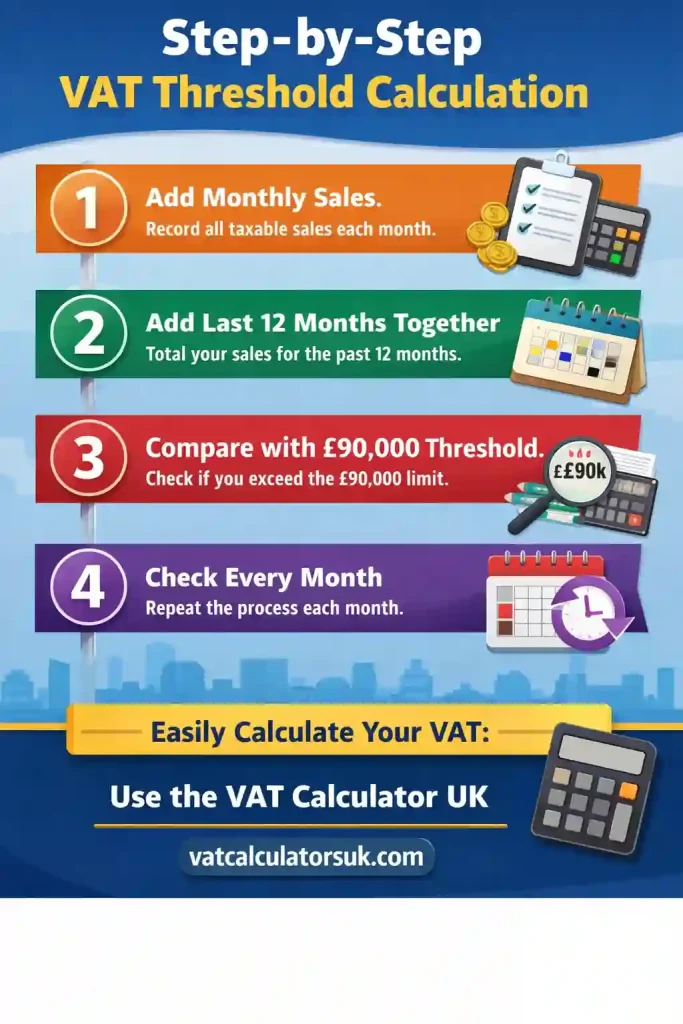
Step by Step VAT Threshold Calculation
Follow these steps to calculate your turnover correctly and understand how to calculate VAT threshold UK without confusion. Each stage helps businesses track income properly and stay within the VAT threshold 2026 UK limit.
Stage 1 : Add Monthly Sales
Begin by recording the total value of your sales for each month, making sure all taxable sales are included even if the amounts seem small. Accurate monthly records help businesses monitor their vat turnover threshold UK and reduce the risk of missing important limits.
Stage 2: Add Last 12 Months Together
After recording monthly figures, add the total from the last 12 months to see your current turnover position. Expenses should not be removed from this total because VAT rules focus only on turnover rather than profit.
Stage 3: Compare with £90,000 Threshold
Once the yearly total is calculated, compare the figure with the £90,000 VAT registration threshold to check whether your business is approaching the limit. If the total reaches or passes this amount, preparation for VAT registration becomes necessary.
Stage 4: Check Every Month
Repeat the same calculation every month to ensure records remain accurate and updated. Waiting until the end of the year increases the risk of late registration, especially for businesses experiencing steady growth.
Businesses that use accounting tools often find turnover tracking easier because modern systems automatically monitor totals and send alerts when limits are close. If you want to estimate your VAT amounts quickly while tracking your progress, you can use: VAT Calculator UK Using a reliable calculator helps businesses stay aware of their totals and reduces the chance of calculation mistakes while managing their VAT threshold 2026 UK position.
Simple VAT Threshold Calculation Example
Let’s take another example to make the calculation easier to understand and show a real vat turnover example UK that many small businesses can relate to.
Sarah runs a small graphic design business. She works with local clients and also sells digital design services online, which means her income grows gradually over time. Tracking monthly turnover tracking UK helps her understand how close she is to reaching the VAT threshold 2026 UK.
Below is her monthly income.
Monthly Turnover Example Table
| Month | Monthly Sales |
|---|---|
| January | £6,500 |
| February | £7,000 |
| March | £7,800 |
| April | £8,100 |
| May | £8,400 |
| June | £8,700 |
| July | £9,000 |
| August | £9,200 |
| September | £9,400 |
| October | £9,600 |
| November | £9,900 |
| December | £10,200 |
After reviewing the table, Sarah adds her total yearly turnover to check whether her business has crossed the limit. If you want to calculate your monthly or yearly VAT amounts quickly, you can use: VAT Calculator UK using a VAT calculator makes it easier to review totals and understand how close your business is to the registration limit.
At the end of December, Sarah checks her total turnover carefully. When she adds all monthly amounts together, her yearly turnover reaches more than £90,000, which means her business has crossed the VAT threshold 2026 UK.
At this stage, Sarah must prepare to register for VAT within the required time frame. If she delays registration, penalties may apply, and those extra costs can reduce business profits.
This example clearly shows how steady monthly growth can slowly push a business over the limit, even when income increases gradually over time. Regular monitoring helps businesses avoid unexpected surprises and stay compliant with HMRC VAT rules.
Benefits of Registering for VAT
Many small business owners see VAT registration as a burden at first, especially when they are close to reaching the VAT threshold 2026 UK. While registration does add responsibility, it also provides several advantages that support long-term growth. Understanding the benefits of VAT registration UK helps remove fear and allows business owners to make confident decisions.
Claim Back VAT on Purchases
Once registered, businesses can reclaim VAT paid on goods and services used for business purposes. This means VAT paid on equipment, software, and office supplies can often be recovered, reducing the total cost of running the business.
For example, if you buy equipment or office supplies, the VAT portion included in those purchases can be claimed back through VAT returns. Over time, recovering VAT regularly can lower expenses and improve overall profitability.
To understand how VAT rates apply to different goods and services, you can check: UK VAT Rates Guide Understanding VAT rates helps businesses calculate reclaim amounts correctly and follow proper HMRC VAT rules.
Improve Business Image
VAT registration often increases customer confidence because many clients view VAT-registered businesses as more reliable and professional. Large companies and corporate clients usually prefer working with registered businesses because VAT invoices show that the company follows proper financial standards.
Even small businesses benefit from this trust because customers feel more comfortable working with businesses that operate under official VAT systems.
Work with Larger Clients
Some large companies require VAT invoices before making payments, especially when working with suppliers or service providers. Registering for VAT allows businesses to work with these larger clients and expand their customer base.
Growth becomes easier when businesses can accept larger contracts and handle bigger projects without restrictions. Understanding the advantages of VAT registration helps businesses prepare for future expansion and financial stability.
Voluntary VAT Registration: Should You Register Early?
Not every business waits until crossing the VAT threshold 2026 UK before registering. Some business owners choose voluntary VAT registration UK earlier because early registration can offer certain financial advantages depending on the type of customers they serve.
The choice to register early usually depends on your business model and customer type. Businesses that mostly work with VAT-registered companies often benefit from early registration because those clients can reclaim VAT, which means charging VAT does not reduce demand.
For example, a freelance designer working mainly with corporate clients may choose early registration because those companies already expect VAT invoices. In such situations, should I register for VAT early UK becomes an important question for growing businesses that want to appear more professional.
However, businesses that sell mainly to individual customers should think carefully before registering early. Charging VAT to individual buyers can increase final prices, which may reduce sales and affect customer demand.
Before making a final decision, business owners should review their costs, customer types, and long-term growth plans carefully. Careful planning helps businesses decide whether early registration is beneficial or whether waiting until reaching the official limit is the better option.
Common VAT Threshold Mistakes to Avoid
Many businesses make small mistakes that later turn into costly problems, especially when they do not fully understand the VAT threshold 2026 UK rules. Learning about these common VAT mistakes UK early helps businesses avoid penalties and stay compliant with tax regulations.
Ignoring Monthly Tracking
Some business owners check turnover only once a year, which creates a risky situation because VAT rules use a rolling 12-month period rather than a fixed yearly total. Monthly tracking is much safer because it helps businesses monitor their income regularly and stay aware of their position.
Ignoring monthly checks often leads to missed warning signs, and many businesses cross the limit without noticing until it is too late.
Confusing Profit with Turnover
Profit is the money left after expenses are removed, while turnover represents total sales before expenses. VAT rules focus only on turnover, not profit, and misunderstanding this difference can create confusion for new business owners.
Confusing these two numbers is one of the most common VAT registration mistakes UK, and it often leads to missed registration deadlines and unexpected tax problems.
Registering Too Late
Late registration can result in penalties, extra payments, and unnecessary financial pressure for businesses. Many owners delay registration because they believe they still have time, but waiting too long increases the risk of falling behind required deadlines.
Planning ahead helps businesses prepare early and reduces the stress that comes with last-minute registration.
Poor Record Keeping
Missing invoices or incomplete records can create serious problems during VAT return preparation. Keeping organized records makes it easier to track sales and calculate VAT totals correctly.
Digital accounting tools help maintain accurate records and reduce the chances of mistakes that could affect compliance with HMRC VAT rules.
How to Monitor VAT Threshold Monthly
Monitoring turnover does not require complicated tools, and even a simple method can help businesses stay within the VAT threshold 2026 UK limit. Learning how to monitor VAT threshold UK regularly helps business owners avoid missing important deadlines and reduces the risk of penalties.
Below is a practical system that many small businesses use to track their monthly VAT turnover tracking UK and stay aware of their registration status.
Monthly VAT Monitoring Table
| Month | Monthly Sales | Last 12-Month Total | Action Needed |
|---|---|---|---|
| January | £7,000 | £65,000 | Continue Tracking |
| February | £7,500 | £72,500 | Continue Tracking |
| March | £8,200 | £80,700 | Watch Carefully |
| April | £8,900 | £89,600 | Prepare Registration |
| May | £9,500 | £99,100 | Register for VAT |
After reviewing the monthly totals, business owners can clearly see how turnover increases over time and how close they are to reaching the £90,000 VAT registration threshold. If you want to calculate your totals quickly or verify your figures, you can use: VAT Calculator UK using a VAT calculator helps track totals accurately and supports better monthly monitoring without complicated calculations.
Once the total crosses £90,000, VAT registration becomes necessary, and businesses must act quickly to avoid missing deadlines. Keeping records in this structured format helps prevent errors and ensures that businesses remain compliant with HMRC VAT rules.
When You Can Deregister from VAT
VAT registration is not always permanent, and businesses can cancel their registration if turnover falls below the vat deregistration threshold UK. Understanding when can you deregister for VAT UK helps business owners decide whether continuing registration is still necessary.
For 2026, the deregistration limit is £88,000, which is slightly lower than the VAT threshold 2026 UK registration limit. If your yearly turnover drops below this level, you may apply to cancel VAT registration and return to non-registered status.
Deregistration can reduce administrative work because businesses no longer need to submit VAT returns or track VAT payments regularly. This change can also simplify accounting tasks and reduce the time spent managing financial records.
However, businesses should carefully review their future growth plans before making a final decision. If sales are expected to increase again, staying registered may be the better choice because repeated registration and deregistration can create additional work and confusion.
Planning ahead helps businesses make smarter decisions and remain compliant with HMRC VAT rules while managing their long-term financial goals.
VAT Threshold for Different Business Types
The VAT threshold 2026 UK applies to many types of businesses, and understanding how the rules affect different industries helps owners plan ahead. Knowing the vat threshold for small businesses UK allows business owners to monitor growth and avoid unexpected registration problems.
Online Sellers
Online stores often experience rapid growth because products can be sold through websites, marketplaces, and social media platforms. As sales increase across multiple channels, turnover can rise faster than expected.
Understanding the vat threshold for online sellers UK is important because digital businesses often scale quickly. Regular tracking of monthly sales helps online sellers stay aware of their position and avoid crossing the threshold without preparation.
Freelancers
Freelancers usually start small but grow steadily as they gain more clients over time. As project numbers increase, turnover can build gradually and eventually reach the vat threshold for freelancers UK.
Freelancers should monitor their monthly income carefully and maintain clear records of invoices. Tracking income consistently helps prevent confusion about when VAT registration becomes necessary.
Retail Shops
Retail businesses handle daily transactions, which means even small sales can add up quickly throughout the year. A busy retail shop may cross the threshold faster than expected due to steady daily income.
Consistent record keeping helps retail businesses stay compliant with HMRC VAT rules and ensures accurate reporting during VAT registration.
Service Providers
Service-based businesses such as consultants, repair technicians, and designers also need to monitor their turnover closely. Even when individual jobs seem small, repeated services throughout the year can gradually increase total income.
Service providers should review their earnings regularly and maintain organized records to stay within the VAT threshold 2026 UK and prepare for future growth.
VAT Threshold FAQs
These frequently asked questions help answer common doubts that business owners search for online, especially when learning about the VAT threshold 2026 UK and related registration rules.
What is the VAT threshold 2026 UK?
The VAT threshold 2026 UK is £90,000, which means businesses must register for VAT once their taxable turnover exceeds this amount within any rolling 12-month period. Monitoring turnover regularly helps businesses avoid missing the registration deadline.
Has the VAT threshold changed in 2026?
No, the VAT threshold remains £90,000 in both 2025 and 2026. The previous limit of £85,000 was increased to £90,000 in 2024, and the same figure continues into 2026.
What happens if I exceed the VAT threshold?
If you exceed the threshold, you must register for VAT within 30 days of the end of the month in which the limit was crossed. After registration, businesses must charge VAT on taxable sales and submit VAT returns regularly.
Can I register for VAT below the threshold?
Yes, businesses can choose voluntary VAT registration UK even if turnover remains below £90,000. Early registration can benefit businesses that mainly work with VAT-registered clients.
How often should I check my turnover?
Businesses should check turnover every month because the VAT threshold uses a rolling 12-month calculation. Monthly checks reduce the risk of late registration and help maintain accurate financial records.
What is the VAT deregistration threshold in 2026?
The VAT deregistration threshold for 2026 is £88,000, which means businesses may apply to cancel VAT registration if turnover falls below this amount. This helps reduce administrative work for smaller businesses.
When do I need to register for VAT after crossing the threshold?
Businesses must register for VAT within 30 days of the end of the month in which their turnover exceeds £90,000. Missing this deadline may result in penalties under HMRC VAT rules.
How is VAT turnover calculated in the UK?
VAT turnover includes the total value of taxable goods and services sold by a business. It does not include expenses or profit deductions, and calculations are based on a rolling 12-month total.
Do freelancers need to register for VAT?
Freelancers must register for VAT if their taxable turnover exceeds the VAT threshold 2026 UK. Even small freelance businesses can cross the threshold as client numbers increase over time.
Does VAT apply to online businesses?
Yes, online businesses must follow the same VAT rules as traditional businesses. If total sales exceed the VAT threshold 2026 UK, VAT registration becomes mandatory regardless of whether sales are made online or offline.
Final Thoughts on VAT Threshold 2026 UK
Understanding the VAT threshold 2026 UK is one of the most important steps for managing a successful business and staying compliant with vat registration threshold UK rules. When turnover grows steadily, crossing the limit often becomes a sign that the business is expanding, but knowing when to register for VAT UK helps prevent delays and unexpected penalties.
Rather than seeing VAT registration as a burden, it is helpful to view it as part of normal business growth. Businesses that prepare early and learn how to calculate VAT threshold UK usually avoid costly mistakes and maintain stronger financial control over their operations.
The key to staying compliant is simple and practical. Businesses should focus on VAT turnover tracking UK, maintain clear records of sales, and act quickly when limits are reached. If you want to estimate your totals quickly and stay aware of your VAT position, you can use: VAT Calculator UK Using a reliable calculator makes it easier to monitor totals and stay prepared for future VAT responsibilities.
By following these steps and monitoring turnover regularly, business owners can stay confident, avoid costly penalties, and continue growing their operations while staying within HMRC VAT rules.