How to Work Out VAT Backwards in the UK (Simple Step-by-Step Guide)
If you run a business in the UK you will often see prices that already include VAT. You may need to remove VAT from the total price. This is called working out VAT backwards. It is also known as reverse VAT calculation. Many business owners get confused here. They try to subtract 20%. That is wrong.
All examples follow current UK VAT rules for 2026. If you want to calculate quickly, you can also use our UK VAT Calculator online tool.
Let’s Start.
What Does Working Out VAT Backwards Mean?
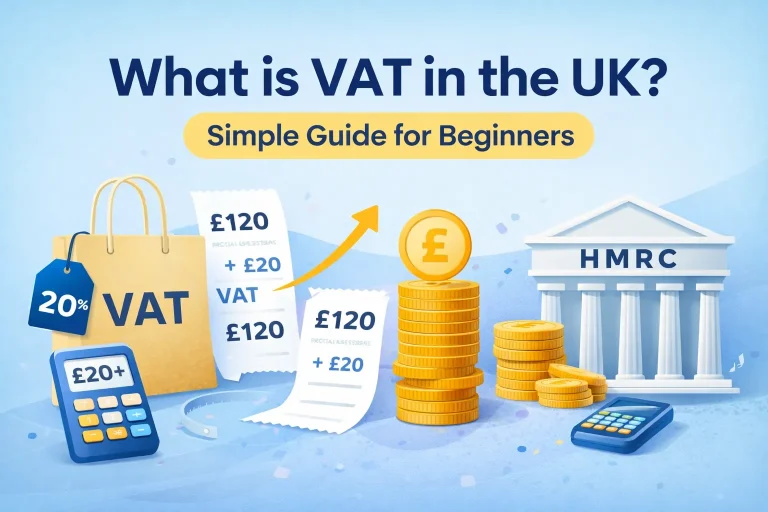
When a price includes VAT, it is called a VAT inclusive price.
Example:
£120 (including VAT)
Inside that £120, part of it is VAT.
Working out VAT backwards means:
- You start with the VAT inclusive price
- You remove the VAT
- You find the original VAT exclusive price
This is common when:
- You receive a receipt with total only
- You need to record VAT for accounts
- You want to know your real profit
- You check supplier invoices
It is very important for VAT registered businesses.
UK VAT Rates Explained (2026)
2026 the UK VAT rates remain:
1. Standard Rate – 20%
This is the main VAT rate in the UK.
Most goods and services use 20% VAT.
Examples:
- Electronics
- Clothing (adult)
- Consultancy services
- Tools and equipment
2. Reduced Rate – 5%
This applies to limited items such as:
- Home energy
- Child car seats
3. Zero Rate – 0%
VAT is charged at 0%.
Examples:
- Most food items
- Children’s clothes
- Books
If you want full details, read our
UK VAT Rate Guide.
The Reverse VAT Formula (20% Standard Rate)
Here is the most important part.
Many people think:
£120 – 20% = £96
That is wrong.
Why?
Because 20% VAT was added to the original price.
You must divide, not subtract.
Correct VAT Backwards Formula (20%)
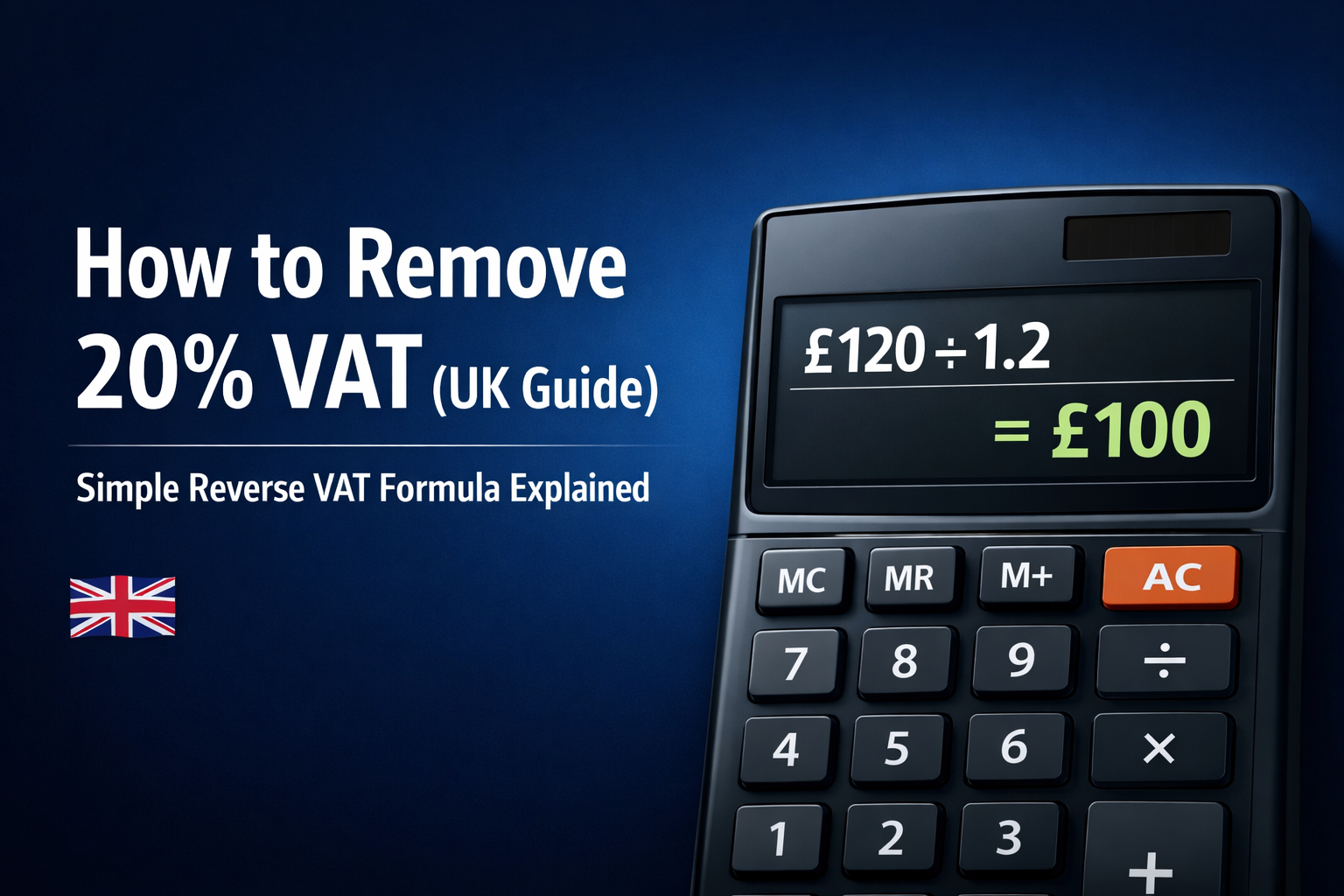
VAT Exclusive Price = VAT Inclusive Price ÷ 1.20
Why 1.20?
Because:
100% + 20% = 120%
120% = 1.20
So dividing by 1.20 removes the VAT.
VAT Amount Formula
VAT Amount = VAT Inclusive Price – VAT Exclusive Price
That is it.
Simple.
Reverse VAT formula example calculation on paper.

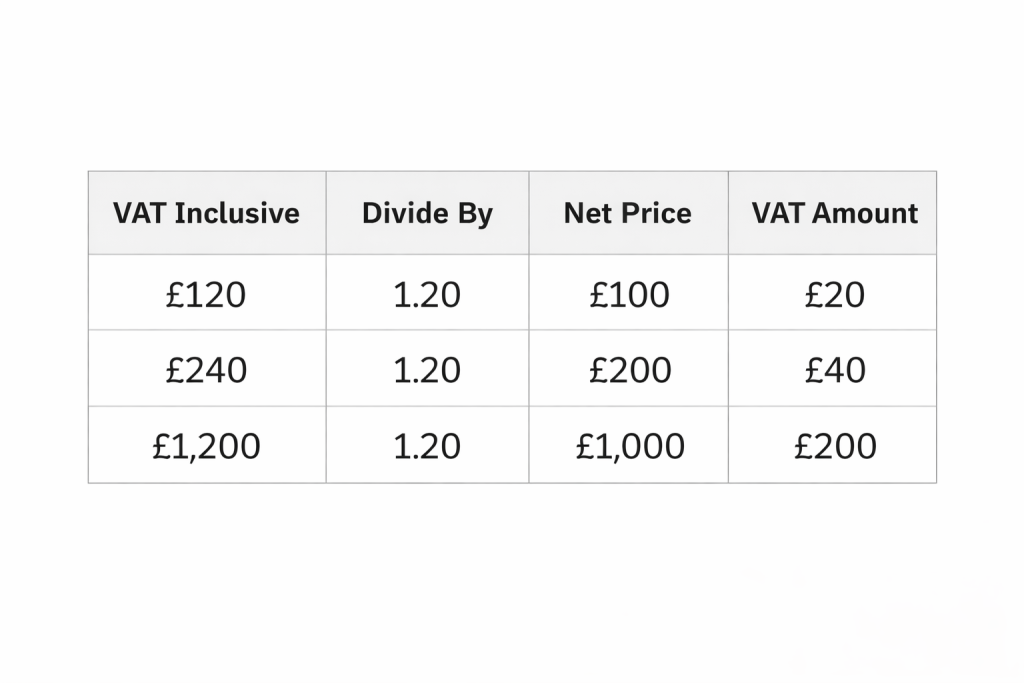
Step-by-Step Example 1 – Removing 20% VAT from £120
Let’s say you have:
Total price: £120 (VAT included)
Step 1: Divide by 1.20
£120 ÷ 1.20 = £100
This is your VAT exclusive price.
Step 2: Find VAT amount
£120 – £100 = £20
So:
- Net price = £100
- VAT = £20
- Total = £120
Simple and clean.
Step-by-Step Example 2 – Removing VAT from £240
Total price: £240 (VAT inclusive)
Step 1:
£240 ÷ 1.20 = £200
Step 2:
£240 – £200 = £40 VAT
Breakdown:
- Net price = £200
- VAT = £40
- Total = £240
Notice something?
20% of £200 = £40
This proves the formula works.
Step-by-Step Example 3 – Removing VAT from £1,200
This is common in business invoices.
Total invoice: £1,200 (including VAT)
Step 1:
£1,200 ÷ 1.20 = £1,000
Step 2:
£1,200 – £1,000 = £200 VAT
Result:
- VAT exclusive price = £1,000
- VAT amount = £200
Now you can record this correctly in accounts.
Reverse VAT for 5% Rate
For 5% VAT, the formula changes slightly.
VAT Backwards Formula (5%)
VAT Exclusive Price = VAT Inclusive Price ÷ 1.05
Why?
Because:
100% + 5% = 105%
105% = 1.05
Example – £105 with 5% VAT
Total price: £105
Step 1:
£105 ÷ 1.05 = £100
Step 2:
£105 – £100 = £5 VAT
So:
- Net price = £100
- VAT = £5
- Total = £105
Very simple.
How to Remove 20% VAT Quickly (Mental Trick)
Here is a quick shortcut.
For 20% VAT only:
Instead of dividing, you can multiply by 0.8333
Because:
1 ÷ 1.20 = 0.8333
So:
£120 × 0.8333 ≈ £100
This is useful for quick checks.
Still, dividing by 1.20 is safer.
Common Mistakes When Working Out VAT Backwards
Mistake 1: Subtracting 20%
Wrong method:
£120 – 20% = £96
This is incorrect.
You must divide.
Mistake 2: Dividing by 20
Some people try:
£120 ÷ 20
Completely wrong.
Always divide by 1.20 for 20% VAT.
Mistake 3: Using Wrong VAT Rate
Check if the item is:
- 20%
- 5%
- 0%
Using wrong rate gives wrong results.
Mistake 4: Forgetting to Keep Records
If you are VAT registered, HMRC expects:
- Correct VAT records
- Correct invoice breakdown
- Accurate VAT return
Why Businesses Need Reverse VAT Calculation
If you run a UK business in 2026, this skill is very important.
1. VAT Returns
When filing VAT return, you must report:
- Output VAT (VAT you charged)
- Input VAT (VAT you paid)
You need the correct VAT amount.
2. Checking Supplier Invoices
Some invoices show only total.
You must extract VAT correctly.
3. Profit Calculation
If you think £120 is profit, you are wrong.
Only £100 belongs to you.
£20 goes to HMRC.
4. Flat Rate Scheme Users
If you use the Flat Rate VAT Scheme UK you still need to understand VAT calculations properly. The scheme changes how you pay VAT, but knowing the maths helps avoid mistakes.
Comparison: Adding VAT vs Removing VAT
Let’s compare clearly.
Adding 20% VAT
Formula:
VAT Inclusive Price = Net Price × 1.20
Example:
£100 × 1.20 = £120
Removing 20% VAT
Formula:
VAT Exclusive Price = VAT Inclusive Price ÷ 1.20
Example:
£120 ÷ 1.20 = £100
One multiplies.
One divides.
[Insert image here: VAT inclusive vs exclusive comparison chart]
When Should You Use a UK VAT Calculator?
Manual calculation is good.
But for:
- Large invoices
- Multiple transactions
- Quick checks
- Error prevention
Use an online tool.
Our UK VAT Calculator
helps you:
- Add VAT
- Remove VAT
- Switch rates
- Get instant results
No maths stress.
FAQ – Work Out VAT Backwards UK
1. How do I work out VAT backwards in the UK?
Divide the VAT inclusive price by 1.20 for 20% VAT.
Example:
£120 ÷ 1.20 = £100
Then subtract to find VAT amount.
2. How do I remove 20% VAT from a price?
Use this formula:
VAT Exclusive Price = VAT Inclusive Price ÷ 1.20
Never subtract 20% directly.
3. What is the VAT backwards formula?
For 20% VAT:
Divide by 1.20
For 5% VAT:
Divide by 1.05
4. What is VAT inclusive price?
A VAT inclusive price already contains VAT.
Example:
£120 including VAT.
5. What is VAT exclusive price?
This is the original price before VAT was added.
Example:
£100 net
£20 VAT
£120 total
6. Is reverse VAT calculation different in 2026?
No.
UK standard VAT remains 20% in 2026.
The formula stays the same.
Final Thoughts
Working out VAT backwards in the UK is simple once you know the rule:
- Divide by 1.20 for 20%
- Divide by 1.05 for 5%
Never subtract the VAT percentage directly.
This small skill prevents:
- Accounting mistakes
- Wrong VAT returns
- Lost profit
- HMRC issues
If you want faster results use our UK VAT Calculator to remove VAT instantly and accurately. Understanding reverse VAT calculation gives you control over your numbers. And control over numbers means control over your business.