What Goods Are Exempt from VAT in the UK? (Simple Guide)
Many people think every product sold in the UK includes VAT (Value Added Tax).
But this is not always true.
Some goods and services are VAT exempt.
Others are zero-rated.
This means businesses do not always charge VAT on every sale.
Understanding this difference is important, especially for small businesses.
If you apply the wrong VAT rule, pricing mistakes can happen.
This can also create problems during VAT returns.
In this guide, you will learn:
- what VAT exempt goods are
- the difference between VAT exempt and zero-rated goods
- common VAT exempt services in the UK
- how businesses handle exempt sales
This simple guide helps beginners understand how UK VAT rules work.
What Does VAT Exempt Mean?
When a product is VAT exempt, businesses do not charge VAT on it.
The customer only pays the base price.
No additional VAT amount is added.
For example:
If a service costs £100, the customer pays £100.
No VAT is included.
However, there is one important rule.
Businesses that sell only VAT-exempt goods usually cannot reclaim VAT on business expenses.
This makes VAT-exempt goods different from zero-rated goods.
Many beginners get confused here.
Understanding this difference helps businesses apply the correct VAT rules.
Difference Between VAT Exempt and Zero-Rated Goods
| Feature | VAT Exempt | Zero-Rated |
|---|---|---|
| VAT charged | No VAT charged | 0% VAT applied |
| Part of VAT system | No | Yes |
| VAT on expenses reclaim | Usually not allowed | Allowed |
| Example goods/services | Healthcare, education, financial services | Food, children’s clothing, books |
Many people believe VAT exempt and zero-rated goods mean the same thing.
They do not.
Both show 0% VAT, but they are treated differently in the tax system.
VAT Exempt Goods
- VAT is not charged
- Sales are outside the VAT system
- Businesses usually cannot reclaim VAT on expenses
Zero-Rated Goods
- VAT rate is 0%
- These goods are still part of the VAT system
- Businesses can reclaim VAT on expenses
This difference is important for accounting and VAT returns.
If businesses misunderstand this rule, they may report VAT incorrectly.
Common VAT Exempt Goods in the UK
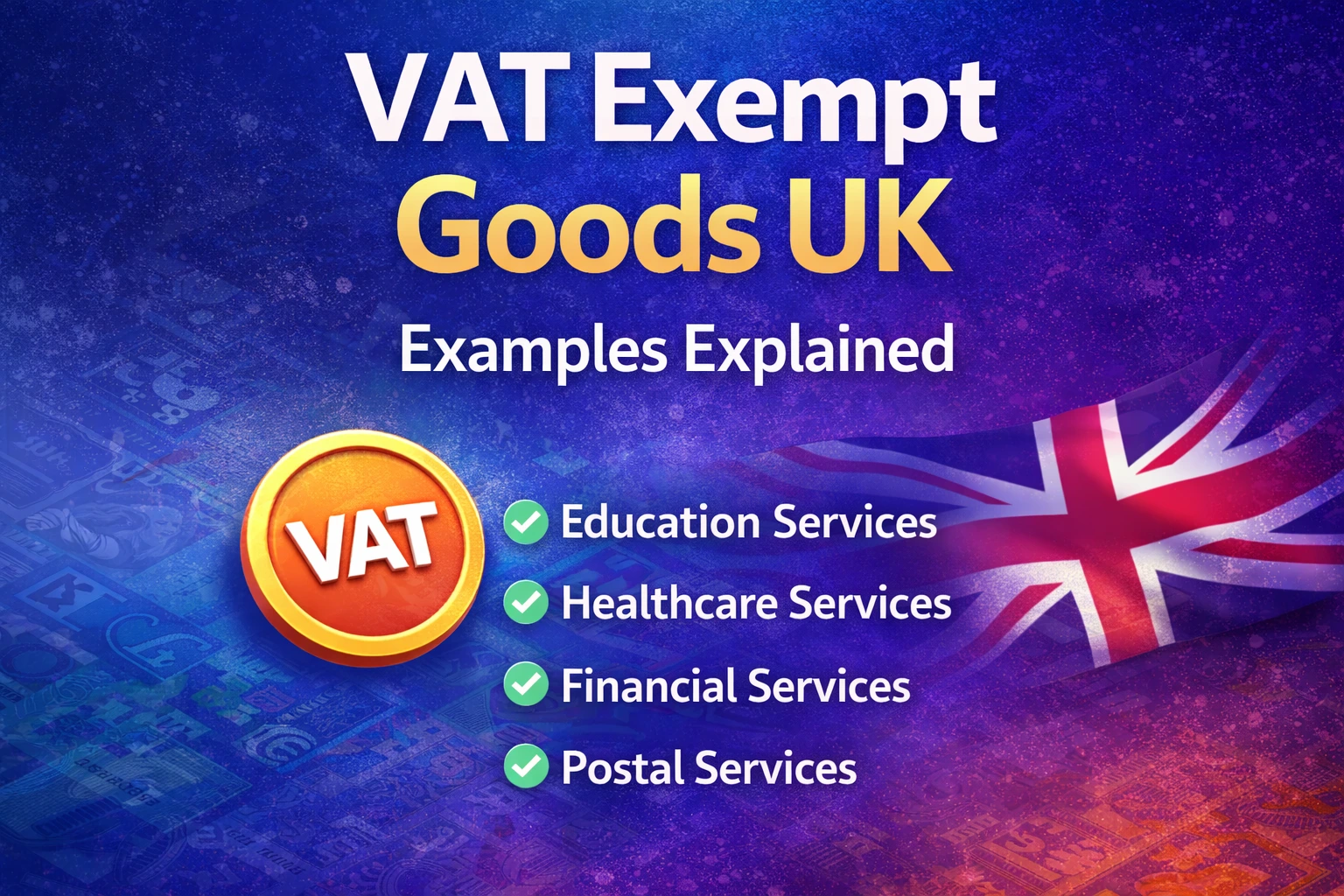
Several services in the UK are VAT exempt.
These exemptions usually apply to important public services.
Below are some common examples.
Financial Services
Many financial services are exempt from VAT.
Examples include:
- bank account services
- loans and credit services
- insurance services
- investment services
These services usually involve financial transactions rather than selling goods.
Because of this, they are often outside the normal VAT system.
Education Services
Education services are also commonly VAT exempt.
Examples include:
- school education
- college courses
- university tuition
- certain approved training programs
However, not every training course is exempt.
Some private training programs may still charge VAT.
Businesses must check the correct VAT category before charging customers.
Healthcare Services
Healthcare is another area where VAT exemption applies.
Examples include:
- doctor consultations
- hospital treatment
- dental care
- medical services provided by licensed professionals
Healthcare services focus on patient care rather than commercial sales.
Because of this, many of these services do not include VAT.
Postal Services
Some postal services are also VAT exempt.
For example:
- standard Royal Mail postal services
However, courier services may charge VAT depending on the service.
Private delivery companies usually apply VAT to shipping fees.
Examples of Zero-Rated Goods
Zero-rated goods are different from VAT-exempt services.
These products still belong to the VAT system.
But the VAT rate applied is 0%.
Common examples include:
- most basic food items
- children’s clothing
- books and newspapers
- public transport fares
Businesses selling these goods must still record them in their VAT reports.
This is why zero-rated goods are not the same as VAT-exempt goods.
Why VAT Exemptions Exist
VAT exemptions exist for social and economic reasons.
Governments remove VAT from services that are considered essential.
These usually include:
- healthcare
- education
- financial services
Removing VAT helps reduce costs for the public.
For example, healthcare and education become more affordable.
This is why these sectors often remain outside the standard VAT system.
How Businesses Handle VAT Exempt Sales
Businesses that sell VAT-exempt goods must follow special accounting rules.
They must:
- record exempt sales separately
- avoid charging VAT on those services
- maintain accurate business records
Things become more complex when a business sells both taxable goods and VAT-exempt goods.
In this situation, businesses may need to calculate partial VAT recovery.
This means businesses can reclaim only part of the VAT on their expenses.
Many businesses work with accountants to manage this correctly.
Using a VAT Calculator for Accurate Results
VAT calculations can sometimes become confusing.
This is especially true when businesses deal with different VAT categories.
Many businesses use a VAT calculator to simplify calculations.
A VAT calculator helps you:
- add VAT to prices
- remove VAT from totals
- calculate invoice values
- check VAT amounts quickly
You can calculate VAT easily using this tool: VAT Calcualtor
This tool allows businesses to calculate VAT in seconds.
It helps reduce manual calculation errors.
Final Thoughts
Understanding VAT exempt goods in the UK is important for both businesses and consumers.
Not every product or service includes VAT.
Some services are VAT exempt, while others are zero-rated.
The difference between these two categories is important.
Key things to remember:
- VAT exempt goods do not include VAT
- Zero-rated goods apply 0% VAT but remain in the VAT system
- Businesses must apply the correct VAT category
- Proper records are necessary for VAT reporting
Using tools such as a VAT calculator can make VAT calculations easier and reduce mistakes.
For small businesses and freelancers, learning these rules helps keep VAT reporting simple and accurate.